Business Hours:
Monday – Friday: 8:00 AM – 12:00 PM, 1:30 PM – 5:30 PM
Hit enter to search or ESC to close
Monday – Friday: 8:00 AM – 12:00 PM, 1:30 PM – 5:30 PM
October 23 2026
THE BUYER'S GUIDE / SELECTION
A buyer-focused guide to deciding when a portable eye wash station fits a site, which published specifications to check (capacity, flow time, pressurization, materials and maintenance), and when a plumbed wall-mounted eye wash station is the better match. Based only on product information published by HEBEI RUNWANGDA LABORATORY EQUIPMENT CO., LTD.
Availability of fixed plumbing at the point of risk
Mobility needs: fixed location versus shifting or remote work sites
Water capacity and continuous flow time (portable: 12 L, 15 minutes listed)
Flow rate (wall-mounted: ≥ 11.4 L/min)
Pressure source and range (portable: manual pumping, up to 2.5 MPa with pressure-reducing valve; wall-mounted: 0.2–0.4 MPa working pressure)
Installation requirement (portable: ready to use; wall-mounted: plumbed and mounted)
Maintenance workload (portable: 90-day water and air replacement; wall-mounted: weekly flushing, filter cleaning, annual duration test)
Construction material (polyethylene versus SS304 or ABS)
A portable eye wash station gives workers emergency eye and face flushing at locations that have no fixed water supply. Before you choose one, check whether the site really needs a self-contained unit or would be better served by a plumbed industrial eye wash station. This guide uses product information published by HEBEI RUNWANGDA LABORATORY EQUIPMENT CO., LTD. It looks at application fit and the specifications buyers should confirm. It does not make claims about pricing, lead times or certifications.
Answer these questions before you compare models:
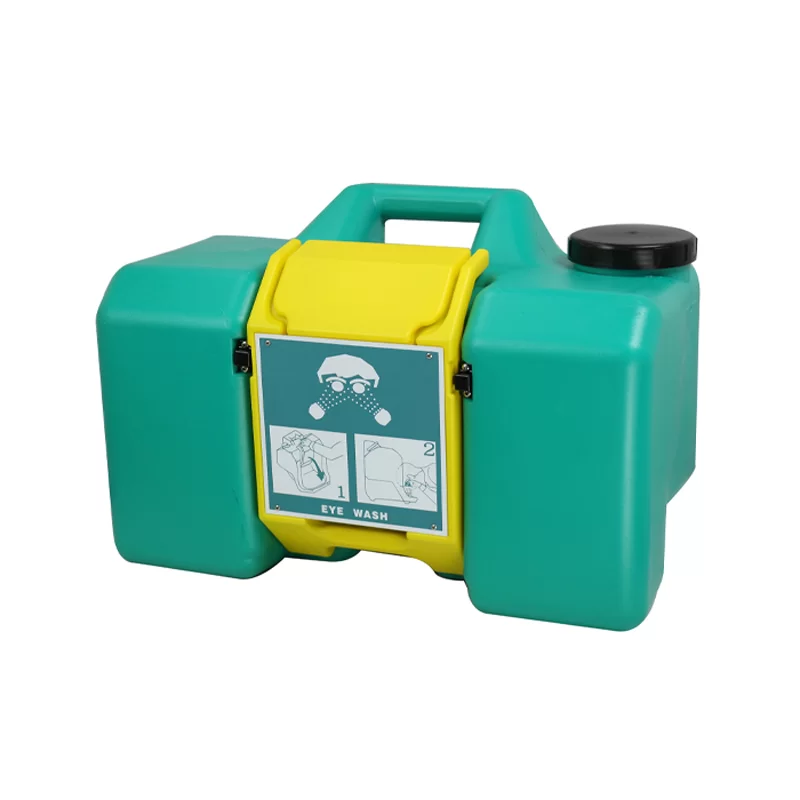
The Portable Pressurized Eye Wash Station is described as a self-contained unit for sites without fixed water sources, such as offshore, desert and industrial sites. Its product page lists these parameters:
| Parameter | Published value |
|---|---|
| Water capacity | 12 liters (purified water) |
| Operating pressure | Up to 2.5 MPa |
| Reservoir material | Non-toxic polyethylene |
| Continuous flow time | 15 minutes |
| Pressurization method | Manual hand pumping |
| Valve type | Pressure-reducing valve |
| Installation | Ready to use, no installation |
| Maintenance cycle | Every 90 days (purified water and air replacement) |
| Storage design | Compact, space-saving design |
The product page also says the pressure-reducing valve is meant to give a steady, non-splashing stream. It says the water outlets are spaced to help rinse both the eyes and the face. Its training guidance refers to manual pumping of about 50 strokes.
What to confirm with the supplier. The published material does not state a flow rate for the portable unit. If your site safety plan or local regulations set a minimum flow rate or a minimum flushing duration, get written confirmation of the unit's flow performance before you buy. Don't infer it from the capacity and duration figures. Also confirm the steps for pressurizing the unit, checking its pressure and refilling it, so they can go into your inspection routine.
If the location has a reliable water supply, a wall-mounted safety eye wash station may suit it better. The wall-mounted model's product page lists:
| Parameter | Published value |
|---|---|
| Material | Stainless steel 304 or ABS |
| Surface finish | Fine-polished or glossy epoxy coated |
| Eye wash switch | Two-piece ball valve |
| Working pressure | 0.2–0.4 MPa |
| Nominal pressure | 1.0 MPa |
| Water flow rate | ≥ 11.4 L/min |
| Ambient temperature | 0 °C to 40 °C |
Its listed features include dust covers that open under water pressure, integrated filter screens and high-visibility green or yellow colors. Its maintenance guidance covers weekly flush checks, filter cleaning and annual 15-minute duration tests.
| Criterion | Portable pressurized unit | Wall-mounted unit |
|---|---|---|
| Water source | Self-contained 12 L reservoir | Building water supply |
| Pressure | Manual pumping; up to 2.5 MPa listed operating pressure; pressure-reducing valve | 0.2–0.4 MPa working pressure from supply |
| Flow data | Flow time of 15 minutes | ≥ 11.4 L/min listed |
| Installation | Ready to use, no installation | Wall mounting and plumbing connection required |
| Mobility | Designed to move between sites | Fixed location |
| Maintenance | Water and air replacement every 90 days; pressure checks | Weekly flushing, filter cleaning, annual duration test |
| Materials | Non-toxic polyethylene | SS304 or ABS |
For portable eye wash station details or a quotation request, see the product page.
THE PEOPLE

About the author
THE COMPANY
Hebei Runwangda Laboratory Equipment Co., Ltd. was established in 1982, with a headquarters area exceeding 26,000 square meters, over 150 employees, and a warehouse area of more than 2,000 square meters. The company focuses on the research and development (R&D) and production of laboratory faucets, gas valves, fume extractors, PP pegboard, PP sinks, emergency showers, and eye wash station, which are widely used in education, scientific research, pharmaceuticals, chemical engineering, petrochemicals, electronics,…
YOUR NEXT STEP
Use case, specification, quantity and delivery window: make the next conversation specific.