Business Hours:
Monday – Friday: 8:00 AM – 12:00 PM, 1:30 PM – 5:30 PM
Hit enter to search or ESC to close
Monday – Friday: 8:00 AM – 12:00 PM, 1:30 PM – 5:30 PM
October 20 2026
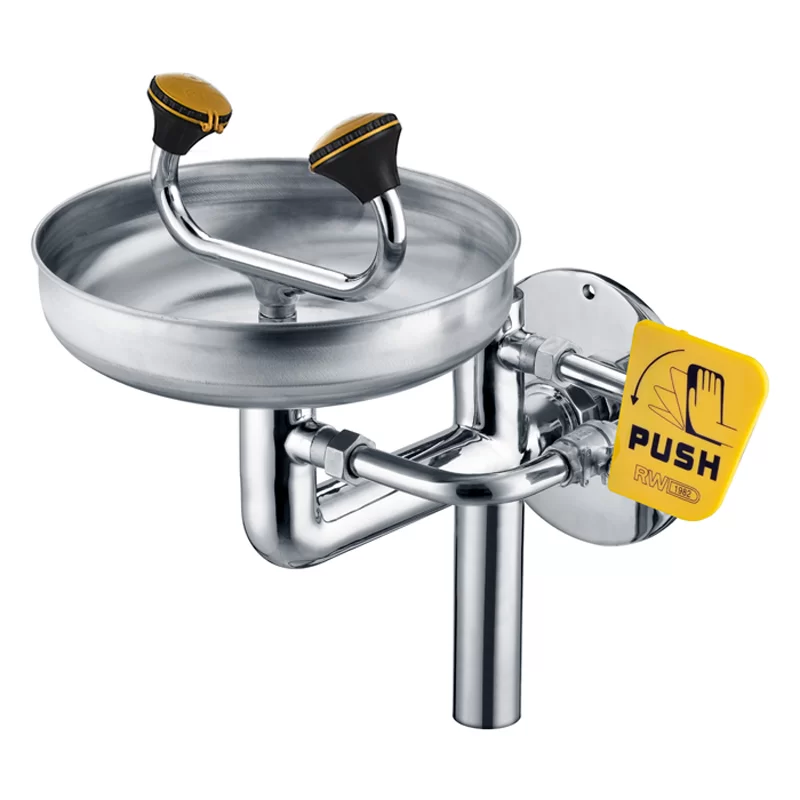
Plant safety engineers and industrial procurement officers evaluate equipment durability by weighing operational facility demands against ambient environmental stresses. This technical guide examines the specific material configuration of the Stainless Steel 304 and ABS wall-mounted eyewash station.
Decision-makers determine whether this hybrid pairing suits specific facility upgrades through systematic material analysis.
Material configuration relies on Stainless Steel 304 and ABS to achieve a stable equilibrium for typical industrial settings. Metal resilience pairs with polymer versatility inside this equipment layout to manage physical stress and fluid contact efficiently.
Load-bearing frames utilize Stainless Steel 304 to maintain structural stability at critical anchor points. Activation paddles and fluid bowls employ engineering-grade ABS to handle operational exposure.
Physical boundaries separate the rigid framing elements from the plastic functional subassemblies. Mechanical integrity depends directly on the metallic spine, whereas chemical containment relies on the molded polymer surfaces.
| material | whether suitable for humid environment | unit price bracket | required documentation |
|---|---|---|---|
| Stainless Steel 304 | yes | variable by order volume | audit verification report |
| ABS | yes | variable by order volume | audit verification report |
Procurement teams review these designated characteristics to align facility upgrades with site environmental demands. Selecting this hybrid division prevents premature component degradation while respecting overall project budgets.
Facility layout decisions must account for ambient moisture accumulation alongside specific fluid splash potentials in active production spaces. When processing environments trap condensation near operational floor plans, localized atmospheric degradation accelerates rapidly on unprotected surfaces.
Interior plant layouts frequently experience fluctuating microclimates where overhead steam lines or washdown routines elevate relative humidity levels. Metal frameworks subjected to persistent atmospheric moisture require careful evaluation against chemical exposure profiles such as acidic cleaning agents or saline mists. These overlapping environmental stresses dictate whether a hybrid assembly maintains structural integrity over multi-year deployment cycles.
Procurement teams weigh ambient moisture metrics directly against the frequency and concentration of potential fluid splashes in designated wash zones. Operating rooms handling corrosive reagents demand precise clearance parameters that depend on destination port routing and specific batch material variations rather than generic assumptions. Industrial buyers evaluate these regional corrosion factors prior to finalizing safety equipment schedules.
Engineering polymer components handle direct fluid contact efficiently, yet prolonged exposure to aggressive solvents requires rigorous verification against manufacturer technical data. Atmospheric salinity combined with chemical runoff creates complex degradation pathways that vary across distinct manufacturing sectors. Safety officers audit these exposure thresholds systematically to prevent premature component failure during high-intensity plant operations.
Rigid load-bearing points rely on the metal structure to withstand continuous operational strain.
High-stress installation zones leverage metal framing to resist physical displacement during emergency activation.
Engineering plastics manage surrounding fluid pathways while absorbing mechanical impacts from daily facility traffic.
| material | whether suitable for humid environments | cost tier | additional documentation required |
|---|---|---|---|
| Stainless Steel 304 | yes | higher | material specification sheet |
| ABS | yes | lower | component compliance file |
Balancing these distinct properties allows procurement teams to meet rigorous durability requirements without exceeding specific purchasing budgets.

Industrial components rarely exhibit universal resistance against aggressive operating environments. Procurement teams should avoid assuming that any hybrid assembly remains completely immune to chemical degradation over extended lifespans.
Facility environments generate unique corrosive vectors depending on ambient chemistry and operational temperature. Material degradation thresholds vary significantly when chemical splashes interact with structural joints. Unverified assumptions regarding chemical tolerance often lead to premature component failure.
Operating context dictates actual performance boundaries in active manufacturing zones. Equipment longevity depends on matching specific fluid exposure profiles against the environmental limits inherent to the configuration, and all chemical degradation limits are to be confirmed with the supplier.
Engineering teams must evaluate active exposure conditions before finalizing installation blueprints. Ambient humidity levels and chemical concentration rates dictate whether the selected assembly maintains structural integrity over time.
Relying on generalized resistance claims introduces critical operational risks. Specific fluid compatibility data must be validated against actual plant conditions rather than presumed baseline limits.
Distribution channels rely heavily on specialized industrial supply partners who stock modular replacement subassemblies. Procurement teams evaluating these pathways must weigh lead times against regional warehouse capacities. Safety directors coordinate directly with regional distributors to secure tiered volume pricing for multi-site facility rollouts.
Purchasing schedules depend on the specific grade availability and the total batch quantity required for plant installation. Factory dispatch windows fluctuate based on order scale, requiring project managers to lock in supplier agreements well ahead of scheduled plant turnaround dates.
Load-bearing wall brackets and mounting plates rely on the metal spine to withstand structural stress at critical anchor points. Molded polymer elements form the activation paddles and fluid collection bowls to manage daily operational handling. This functional split ensures that physical impacts and wall loads transfer securely through rigid framing while functional surfaces handle fluid contact.
Industrial components combining metal and engineering plastics remain susceptible to localized degradation under extreme exposure conditions. Material suitability depends entirely on matching the specific operating context against known chemical compatibility parameters rather than assuming universal resistance. Maintenance schedules should account for routine inspections in high-salinity or heavy acid exposure zones.
Combining structural metal with engineering plastics balances high-stress mechanical durability against strict project budget constraints. The metallic framing prevents structural sagging at fastening points, while molded polymer components reduce overall unit weight and material acquisition costs. Procurement officers utilize this balance to secure heavy-duty wall anchoring without overspending on unnecessary full-alloy fabrication.
Sourcing strategies for dual-material eyewash units typically factor in standard industrial distribution lead times and component manufacturing schedules. Safety equipment upgrades align with planned facility maintenance windows to avoid operational downtime during installation. Bulk purchasing decisions depend on project scale, destination port logistics, and the verified availability of component stock from distribution channels.
Procurement teams review official manufacturer documentation and whitelist material sheets rather than relying on third-party marketing claims. Cross-referencing component composition involves matching exact grade designations against internal safety engineering standards. Final verification depends on obtaining certified technical data directly through authorized supply chain communication channels before finalizing purchase orders.
Facility decision-makers must coordinate internal engineering teams and external suppliers efficiently prior to placing bulk orders. Final purchase contracts depend entirely on negotiated trade volumes, local shipping distances, and specific harbor logistics terms.
Purchasing agents often request comprehensive testing dossiers before signing off on large-scale infrastructure deployments. These dossiers must be reviewed thoroughly by quality assurance personnel to confirm alignment with facility safety policies.
Procuring teams verify these material properties through systematic document audits rather than relying on promotional summaries. Successful safety equipment integration relies on continuous cross-departmental communication between plant operators and the designated parts provider.